
Hello, my name is Sato and I run J-CLINIC, a physiotherapy and acupuncture clinic in Bangkok.
Recently, we’ve been receiving many inquiries from parents whose child who got hurt while playing on the trampoline and needed treatment.

Common trampoline injuries
Trampolining is fun—who doesn’t enjoy jumping high and floating in the air?

But trampolining can also easily lead to injuries. If you haven’t mastered the basic jumping techniques, you can strain your ankles and knees. In this article, I’ll talk about common trampoline injuries, how to treat them, and how to prevent them.
Common injuries from trampolining include
- Missing a landing and twisting your ankle
- Landing on a spring frame and injuring your ankle or knee
- Bumping into someone, falling over, and hurting your neck or back
- Falling over from a mistimed jump and landing on and hurting your wrist
The most common trampoline injury: Sprains
The most common trampoline injury among patients who come to our clinic is sprains.

Many of our clients tell us, “It’s just a sprain, so I thought it would heal if I put a compress on it.” But if you’ve twisted your ankle hard, the ankle ligaments may be torn or partially damaged. So it’s important to receive treatment as soon as possible.
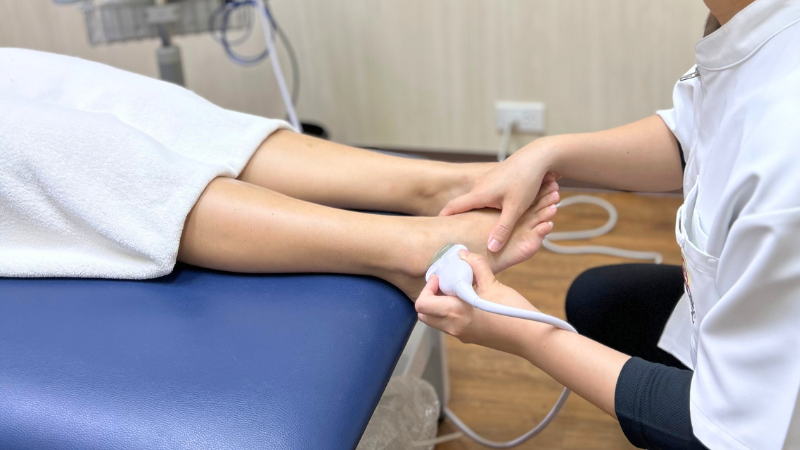
Treating sprains at J-CLINIC
J-CLINIC will treat your sprains with ultrasound/high-voltage therapy, manual therapy and taping, and give you rehab guidance.
Ultrasound/high-voltage therapy to relieve pain
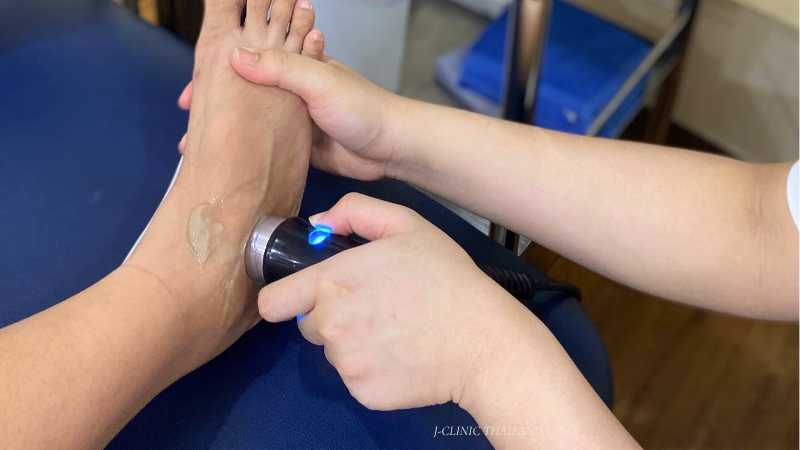
We’ll relieve your pain with a combination of (1) high-voltage electricity to loosen tension in the superficial muscles and (2) ultrasound to relax the deeper muscles that can’t be reached by hand.
This combination therapy also repairs cells and is one of the most popular forms of care used by professional athletes.
Manual therapy and taping
We use massage to loosen muscle tension around the ankle. Taping then immobilizes the ankle, which will speed up the healing process.
Taping
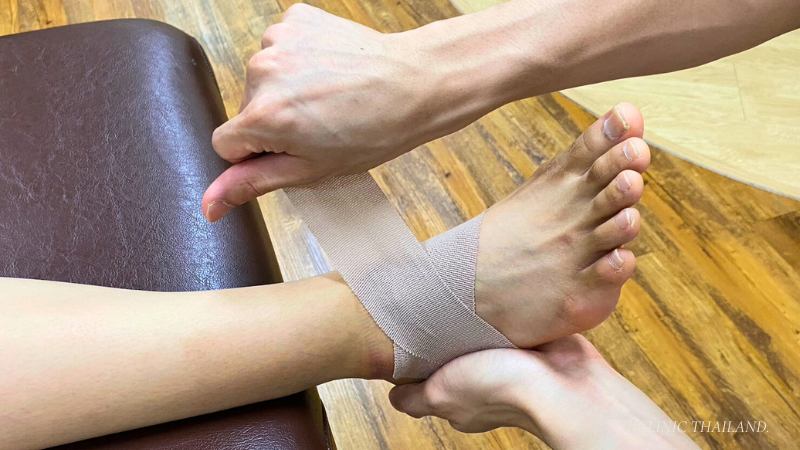
Training and self-care guidance
After the pain subsides, we’ll show you exercises to do at home and self-care tips to prevent repeat injuries.

Ankle Stability Exercise (Toe Calf Raises)
Strengthening your shin and calf muscles to help prevent future sprains. Stand on your toes and then lower your heels. Repeat. If you put a Pilates ball between your knees while doing this exercise, you can strengthen your inner thigh muscles at the same time.
Calf Strengthening for Ankle Support
Using a Thera-Band to stretch and strengthen your shin and calf muscles. Like the above exercise, this will help prevent future sprains.
Achilles Tendon Self-Release with a Massage Ball
Using massage balls to soften the Achilles tendon. Greater flexibility in your Achilles tendons will increase your ankle’s range of motion and make it harder to sprain your foot.
How to avoid injury on the trampoline
Here are some things you can do to avoid injuries on the trampoline.
- Warm up: Before jumping, stretch your lower body. Rotate your ankles and stretch your Achilles tendon.
- Learn the correct posture and style for jumping. Keep your posture upright when jumping. Beginners should first learn to jump up straight, landing in the same spot that they took off.
- Train the muscles of the lower body. Especially strengthen your shin and calf muscles to ensure a stable landing.

First aid for sprains
If you suffer a sprain, icing is the first step in first aid. Icing will help you recover quickly.

If you are at a trampoline park, it might be a good idea to take a lesson with an instructor the first time. Learn how to jump correctly and enjoy trampolining without getting hurt!
If you suffer from sprains or other foot injuries in Bangkok, get in touch with us by phone, Contact form or Facebook.
Making a appointment
📞For Booking
- Phrom Phong: 097-257-3577
- Thonglor: 084-424-1299
- Ekkamai: 097-245-7863
We are also on LINE! Add J-CLINIC Official on LINE (each branch has its own QR code)